Cheap Round Trip Flights vs Two One-Way Tickets: Which Costs Less?
Round trip or two one-way tickets? A side-by-side comparison of price, flexibility, baggage and risk, with a simple way to check both before you book.
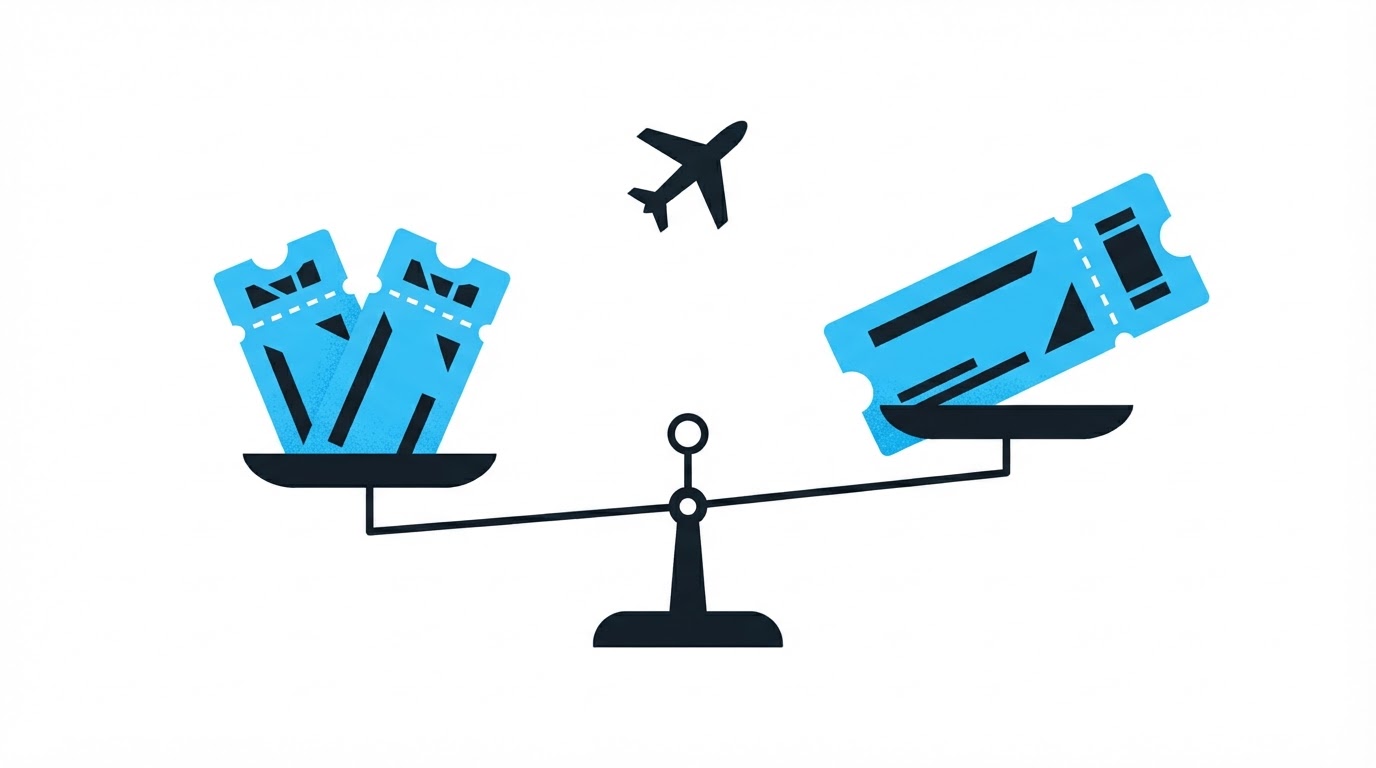
A round trip is often the cheaper way to fly, but two one-way tickets can win on some routes and give you more freedom. The only way to know is to price both for your exact dates, then compare the total including bags and change fees. This article shows what to compare and how to do it in a few minutes.
The short answer
- Choose a round trip when you fly the same airline both ways, you have fixed dates and you want one booking to manage.
- Choose two one-way tickets when your return date is uncertain, when you want to mix airlines, or when the one-way fares are clearly lower in the search results.
- Choose an open-jaw ticket (into one city, out of another) when your trip is a line, not a loop.
Neither option is always cheaper. Prices depend on the route, the dates and the airline, so check both every time.
Side by side
| Round trip | Two one-way tickets | |
|---|---|---|
| Price | Often lower on one airline, but not always | Can be lower, especially on budget carriers |
| Flexibility | Changing one leg may affect the other | Each leg is independent |
| Mixing airlines | Usually one airline for both legs | Any airline for each leg |
| Baggage | One set of rules | Two sets of rules, check each leg |
| Risk if you miss a leg | The rest of the ticket may be affected, check the fare rules | The other ticket is separate |
| Searching | One search | Two searches, or a one-way option in the search tool |
When a round trip usually wins
A round trip is a good default for a simple trip with fixed dates. You search once, you see one total price and the rules are the same in both directions. On long routes with full-service airlines, the round-trip price is often lower than the sum of two one-way fares, though you should still check. If you want a refresher on how to search, see our guide on how to find cheap flights step by step.
When two one-way tickets can win
Two one-way tickets are worth a look in these cases:
- You are not sure when you will come back. Booking only the outbound leg lets you decide later, although the return price may be different when you finally book.
- Each direction is cheapest on a different airline. Mixing airlines is the main advantage of one-way tickets.
- You are flying with a budget carrier. These carriers often price each direction separately, so a one-way fare is not a penalty. Compare the total with bags and seats, as explained in low cost airlines vs full service airlines.
- You are ending your trip somewhere else. If you arrive in one city and leave from another, you do not need a return to the start.
Our guide to how to find cheap one-way flights covers this case in more detail.
The risks of two separate tickets
Two tickets are two contracts. If the first leg is delayed or cancelled, the airline on the second ticket owes you nothing. This matters most when the two tickets are part of one journey, such as an outbound flight with a connection on a different booking. Leave a long buffer, or keep the connection on a single ticket. For a simple outbound and a simple return, the risk is small, because the legs do not depend on one another.
How to check both in five minutes
Google Flights lets you choose between one-way, round trip and multi-city at the top of the search, as described on Google's help page. Its calendar shows the lowest total price for each day, and its price graph helps if your dates are flexible.
- Search the round trip for your dates and note the total price.
- Switch to one-way and search the outbound flight. Note the price.
- Search the return flight as a one-way. Note the price.
- Add the two one-way prices and compare them with the round trip.
- Add the bags, seats and change fees on each option, then compare again.
- If the difference is small, take the option with the better rules and flexibility.
Using alerts to catch a lower price
Whatever you choose, the price you see today is a snapshot. Google Flights can email you when the price of a tracked route changes significantly, as described on Google's price tracking page.
Cheap Flights Alert approaches it from your home airport. You pick the airport and a channel (WhatsApp, Telegram or email), and it sends a message when a fare from that airport is clearly cheaper than usual. Each alert has the price, the travel dates and a direct link to book, and only deals scoring 80% or more against recent prices are sent. The service is free, you sign up at /alerts with an email link and no password, and you can unsubscribe at any time.
There are limits. It does not sell tickets, it does not predict prices, and it does not guarantee that the price will still be there when you book. If you need a specific route on specific dates, a flight search tracker is the more direct tool. For a feel of what a good fare from your airport looks like, open your airport page, for example Chicago, and read the lowest fare, the 30-day low and the update date. As of 7 November 2026 that page showed a lowest fare of $111 (to Fort Lauderdale) and a 30-day low of $68. Those are domestic fares and they change daily, so use them as a way to learn the page, not as a promise.
A simple rule to remember
Price the round trip, price the two one-way tickets, add the extras, and pick the lower total with the rules you can live with. Then set an alert and wait for a fare that is clearly below what you saw.
Sources
Frequently asked questions
- Is a round trip always cheaper than two one-way tickets?
- No. It is often cheaper with one airline, but two one-way tickets can win, especially with budget carriers or when you mix airlines. Price both for your dates.
- What is the main risk of two one-way tickets?
- They are separate contracts. If a delay on one ticket makes you miss a flight on the other, the second airline may owe you nothing, so leave a long buffer for connections.
- How do I compare the real price of each option?
- Add bags, seat selection and change fees to each fare, then compare the totals instead of the headline prices.
- When is an open-jaw ticket a good idea?
- When you arrive in one city and leave from another, because it saves a trip back to your starting point. Price it next to the round trip.
- Does Cheap Flights Alert show round trip or one-way fares?
- Each alert includes the price, the travel dates and a direct link to book. Check the booking page for the exact ticket type and rules before you pay.
Your next trip could cost far less
Why pay more? Join free and let the deals come to you.
Join for free